Categories
MSPress Announcements

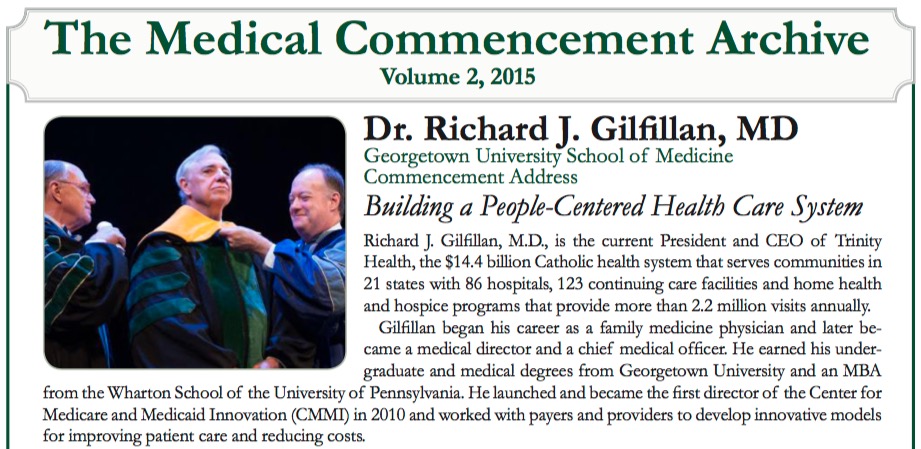
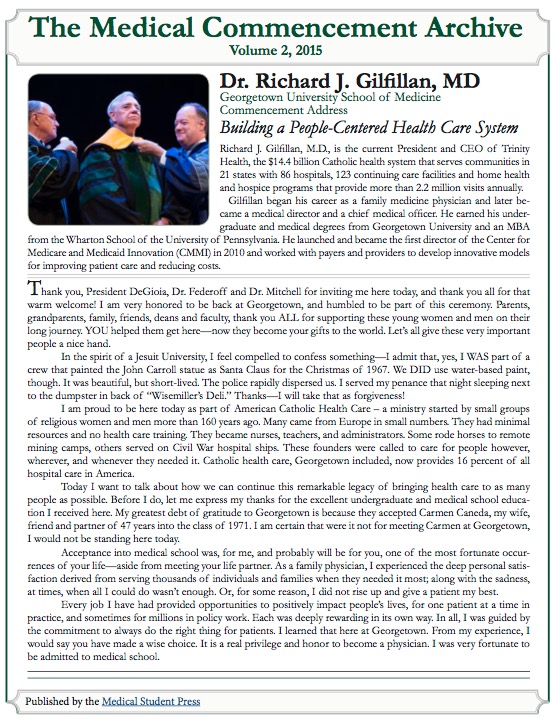
“Building a People-Centered Health Care System” Dr. Richard Gilfillan, 2015 Commencement Address of Georgetown University School of Medicine

This week, Dr. Richard Gilfillan’s 2015 commencement speech at Georgetown University School of Medicine entitled, “Building a People-Centered Health Care System” debuts on the Medical Commencement Archive.

Screen Shot 2015-08-14 at 10.16.35 PMDr. Gilfillan has been a leader in U.S. health care for over 25 years, developing organizations to deliver stronger health outcomes. Gilfillan began his career as a family medicine physician and later became a medical director and a chief medical officer. He earned his undergraduate and medical degrees from Georgetown University and an MBA from the Wharton School of the University of Pennsylvania.

He launched and became the first director of the Center for Medicare and Medicaid Innovation (CMMI) in 2010 and worked with payers and providers to develop innovative models for improving patient care and reducing costs.

He is currently the President and CEO of Trinity Health, the $13.5 billion Catholic health system that serves communities in 21 states with 86 hospitals, 126 continuing care facilities and home health and hospice programs that provide more than 2.2 million visits annually.

Dr. Gilfillan’s speech revolves around the idea of innovating opportunities for bringing health care to as many people as possible in the country.

“Taking the perspective of a person or family being cared for in our system we ask ourselves how would we choose priorities, design the lab, or set visiting hours sensibly? We integrate the resulting ideas into our conversation. Doing this significantly expands our thinking and will lead to better decisions.”

He concludes by advising the graduating class to incorporate five principles into their daily encounters with patients and hospital staff:

“Be humble. Be curious. Be bold.Laugh a lot, enjoy your work, and celebrate your team.And remember that listening well to your patients is the starting point of great patient care.”

Read Dr. Gilfillan’s speech and the rest of the Archive here: The Medical Commencement Archive

Categories
General Reflection

Can Empathy Be Taught?

As medical students, we are taught to examine patients, recognize symptoms, and treat diagnoses. We get lost in the sea of differential diagnoses and worries of exams. I always worried that I’ll never remember all the important facts, that I’ll miss an important sign or symptom or forget an essential part of treatment in an emergency situation. When I faced my real-life patients, I realized that I was indeed not ready. Surprisingly though, it wasn’t the lack of theoretical or practical knowledge that worried me anymore, but the fact that each patient required a different approach. Some patients are serious and to the point, others are full of witty remarks about not only their condition, but all sorts of topics. Some don’t want to know much about what’s happening to them, while others have countless questions. Their behavior might be a part of their usual personality, or it could be changed because they have found themselves in a new, often scary situation. I wanted to, had to, understand why each of my patients acted and thought the way they did, so that I could adapt my manner, make them more comfortable, find out more information, and finally, earn their trust.

In observing my seniors, doctors with years or decades of experience, I have noticed their style of communication with patients comes from every part of the spectrum. Some are empathetic and communicative, dedicating a large portion of their time to their patients; others are introverted, avoid communication with patients at all costs, or can even be patronizing and show little understanding.

In the past, medical education focused primarily on academic knowledge and practical skills. Today, however, the importance of doctors’ communication skills has obviously been recognized and integrated in our education. But can empathy be taught?

We can learn to shake a patient’s hand, to ask for permission before examining them, to perform other small actions that take little effort but make our patients much more comfortable. In order to better understand our patients, to get them to open up more easily and reveal parts of their medical history they would otherwise conceal, to treat them in the most individual manner possible, we need to empathize with them. I’ve seen my colleagues to whom this comes naturally, but I’ve also seen others whose attempts at empathy take a lot of effort and energy.

Because I am at the very beginning of my medical career, I realize my point of view might be naive. Still, at this point I believe I should focus on each patient. I should empathize and understand each individual fully before attempting to tend to his or her troubles, however much energy that takes. I am also worried about the possibility that this ability can be lost. I often wonder if the more reserved senior doctors have always been that way, or if their energy and will to empathize have been lost after seeing innumerable patients.

I don’t know if empathy can be taught in classes, but I do believe everyone can develop it. Unfortunately, I think the ability to empathize can also be lost. Ultimately, this social dimension of medicine remains different for each health professional, and their ability or will to empathize remains their choice, depending on how they choose to integrate their theoretical knowledge and experience with their personality.

Featured image:
empathy by Sean MacEntee

Categories
General MSPress Announcements

“The Compassionate Physician Discoverer” Dr. Barry Coller, 2015 Commencement Address of the Northwestern University Feinberg School of Medicine

This week, Dr. Barry Coller’s 2015 commencement speech at Northwestern University Feinberg School of Medicine entitled, “The Compassionate Physician Discoverer” debuts via the Medical Commencement Archive.

Screen Shot 2015-08-13 at 3.07.39 PMDr. Coller is a respected educator and a leader in hematological research. He graduated from Columbia College in 1966, received his M.D. from New York University School of Medicine in 1970 and completed his residency in internal medicine at Bellevue Hospital and advanced training in hematology and clinical pathology at the National Institute of Health. He is currently the David Rockefeller Professor of Medicine, the Head of Laboratory of Blood and Vascular Biology, Physician-in-Chief of The Rockefeller University Hospital, and Vice President for Medical Affairs at The Rockefeller University. He also serves as the founding Director of the Rockefeller University Center for Clinical and Translational Science. Dr. Coller’s research interests have focused on hemostasis and thrombosis, in particular platelet physiology. He helped developed abciximab which, to date, has treated over five million patients – I’m sure we’ve all heard that drug in pharmacology many times!

Dr. Coller began his address by reflecting upon, what he believes, are the two pillars of medicine: science and humanism.

“The expert physician has a comprehensive and deep scientific understanding of the causes of illness and the rational basis of disease prevention and therapy; the compassionate physician applies that knowledge with sensitivity to the unique needs and circumstances of a single complex individual.”

He further explains that medical humanism has five core elements: the preciousness of human life, respecting and protecting a patient’s dignity, celebrating human diversity, sympathetic appreciation of the complexity of the human condition and lastly, a commitment to social justice, universal access to medical care, and global responsibility.

Of course, a leader in research will not fail to emphasize the importance of furthering science:

“…I appeal to each of you to be a medical discoverer by which I mean applying the scientific method to address a health need… you live in an age of ever faster technologic change, much of which meets the criterion of disruptive innovation, wherein new technology does not simply improve on previous technology, but forces radical transformation.”

At the end of his speech, Dr. Coller concludes with this piece of wisdom:

“Art, literature, poetry, theater, and cinema help you keep the patient’s perspective before your eyes, but nothing is as good as really listening to your own patients, sympathetically hearing their life story, and learning what they have teach you. And nothing is as rewarding.”


Categories
Lifestyle Narrative Reflection

Lonely in a Room Full of People

Stock phrases:

“Hey mon, you alright?”
“You have a blessed day.”
“How is your morning walk pretty ladies?”
“Yeah mon, no worries. Everything alright.”

These ‘stock phrases’ are just a few of the things I heard each and every day while staying in Negril, Jamaica. I travelled to the island to take a short vacation and attend a destination wedding this past month. While on the island, I was pleasantly greeted by the local Jamaicans any time I left the bed and breakfast I stayed at. I was surprised at first at how friendly the locals were – I had heard from friends to be cautious of the crime in Jamaica. Nevertheless, I always responded to the locals, asking them how they were.

A few days into my trip I was with a Jamaican driver named Patcha, headed to another part of the island. I chatted with Patcha for quite a while. I asked him about his culture – his views on marriage, money, economy, etc. He was open and never held anything back. I mentioned to him how friendly I thought the Jamaicans all were. He kind of chuckled and asked if that was out of the ordinary for me. I told him America was different.

I went on to tell him that I am guilty of being unfriendly at times; not intentionally, but just by habit. He didn’t quite understand. I told him how common it is in America to be walking in a hallway or down a street with one other person and for neither of them to say hello to one another. Some people even say they feel lonely in a room full of people. He burst out laughing.

I started laughing too. Why do we do this? What stops us from just initiating a conversation with others? He asked why this is so. I started thinking and said, “Maybe it is because Americans are too stressed. We forget about other people because we are kind of on a mission each day.” Patcha responded, “Us Jamaicans are stressed too, we need to have food on the table every night.” I bit my tongue remembering Patcha had told me earlier that many Jamaicans live in poverty. He told me workers at some of the larger all-inclusive resorts on the island make only about ten US dollars a day and smaller establishments tend not to pay their workers on time or abuse their power over their employees in other ways.

Clearly, stress is a problem in Jamaica just as it is in America. So why is it only in the US where we insist on emotionally walling ourselves off? Why do we stray away from human contact when it is so easy to make a connection with another human? I couldn’t give Patcha an answer. I have been a shy person for the majority of my life, but by no means am I scared to strike up a conversation with anyone. When I returned to the United States I noticed myself falling into old habits, just politely smiling at the person next to me in line for coffee, but never saying hi or asking the how their day is going.

I wanted to write this blog post to hold myself accountable and also challenge my readers to break the silence. Say hello to strangers. Dare yourself to give someone a compliment. Make yourself more human.

As future medical professionals, part of our responsibility is to make our patients comfortable. I will count this challenge as daily practice for my career. I’ve seen many doctors put on a positive attitude for their patients, only to find them miserable when engaging in other social interactions. What makes a stranger in the grocery store any different from a patient in the hospital?

I hope this short story will help readers see that sometimes we all need a reality check. Whatever the reason is, our culture is heading down a path of loneliness, instead of solidarity. Let’s all take responsibility for this and make changes to unite one another.

Featured Image:
Humanity by Kevin Dooley

Categories
MSPress Announcements

“Declaring an Affirmation of Commitment” Dr. Robert Folberg, 2015 Commencement Address of the Oakland University Beaumont School of Medicine

Screen Shot 2015-08-01 at 11.01.57 AMVolume 2 of the Medical Commencement Archive comes from Dr. Robert Folberg at Oakland University Beaumont School of Medicine’s charter class’ commencement. Dr. Folberg’s address, Declaring an Affirmation of Commitment, reflects not on the definition of being a good physician, but on being a good human being. Dr. Folberg is the Founding Dean of OUWB, as well as the Chief Academic Officer at William Beaumont Hospital. As a proud student of OUWB myself, I couldn’t help but debut this year’s Archive with my university’s Dean – a man who has never failed to give mini-motivational speeches in the hallway before exams and is always happy to attend and support student organization events.

Dr. Folberg revolves his speech around two questions: what do I want to do, and who do I want to be? Although to some, those two questions may inspire the same answer, Dr. Folberg stresses that the second question embodies a commitment beyond profession.

To answer the second question – who do I want to be – requires training, practice, and commitment. You were invited to come to OUWB because you excelled academically and because you provided evidence to us of experiences and attributes that predicted you would become physicians who are empathetic, compassionate, and engaged.

He continues by emphasizing the Declaration of Geneva, an oath that each study took upon receiving their first white coat. Each class at OUWB has the opportunity to make unique additions to the Declaraton of Geneva, reflecting upon the promises they hope to fulfill throughout their careers.

You recognize that we all have conscious and even unconscious biases that, if unchecked, could compromise our ability to practice medicine. How could we allow our biases to interfere with the practice of medicine if everyone has infinite value?

At the end of his speech, Dr. Folberg quotes an original line from the Declaration of Geneva: “I will give to my teachers the respect and gratitude that is their due,” and humbly titled each student as his new teachers in the profession of medicine.

Frequently, stymied by a case that challenges my abilities, I turn to my younger colleagues for help, and often, these are the very individuals who were my students. In a very real sense, I owe to them, my students, the respect and gratitude that is their due.

Volume 2 of the Medical Commencement Archive has a fantastic line-up this year! A new speech will be published each Friday.

Visit the Medical Commencement Archive

Categories
Lifestyle Reflection

The Hypocritical Oath

Taking the Hippocratic Oath is a rite of passage. Before any physician enters Exam Room 1, he recites these words, written by Hippocrates centuries ago. These words are powerful; so powerful that they are treated as more than just words. These words represent a physician’s love and devotion to his patients.

No matter how stressful this field can be, I have always seen physicians set these words—the oath—as their standard. As physicians (or budding physicians, in our case), we tell others to fill their bodies with nourishment and to practice a variety of healthy habits. But, the question remains: do we treat our own bodies the same way?

As a public health major, I’m all about “prevention.” My special interest is the prevention of chronic disease. Whenever I go home, I am the first to scrutinize my parents’ pantry—making sure their ketchup is devoid of high fructose corn syrup and that their fridge is filled with raw food. When I talk to my friends or relatives, I push them to exercise because “it really only takes thirty minutes of your day, and you’ll feel amazing afterwards!”

Basically, I play the pushy health coach. But is this health coach all talk and no walk?

Sadly, I don’t always abide by the values I preach. Even though I know I should be drinking water equivalent to half my body weight in ounces, I generally don’t. Well, why not? Sometimes I don’t make it a priority, and other times I forget. Many patients probably experience a similar scenario. Likewise, I often see my fellow classmates put academics above their health at school. I can be guilty of this too.

When I started thinking about our habits, I was hard on myself and my peers. As healthcare practitioners, our own health should never be placed on the backburner. More importantly, I don’t like the idea of telling my patients to do A, B, and C if I can’t do A or B or C myself. It just doesn’t seem very reasonable. I’ve come to the conclusion that there are two ways I can approach this in the future:

  1. Practice what I preach
    OR
  2. Preach with empathy

I’ve realized it’s okay to push those I love to be better, even if I’m far from that point myself. But this conversation should be accompanied by a discussion on health barriers. It’s hard to get your limp legs out of a warm bed in the morning, but what will help you rip off the covers and jump on the treadmill? Sleeping with your sports bra on? Placing your alarm farther away from the nightstand? We all know what “healthy” looks like; what we don’t always know is how to achieve it. I want to share my own obstacles with patients while also discussing theirs.

Bottom line: I don’t have to be perfect to offer health advice…I just need to be compassionate.

Featured image:
The road to health by Sarah Joy

Categories
Clinical

Journey to the Center of the Lab

What is a stat laboratory? As far as most doctors are concerned, the stat lab is a mysterious place, located somewhere in the dungeon of the hospital, wherein a slew of unkempt “lab people” feverishly work to turn tubes of blood into useful numbers in the electronic medical system. While this view is not a complete misconception, I do think it would be constructive to provide a quick overview of how exactly these labs work, and how they fit into the overall healthcare picture.

There are two kinds of laboratories in the healthcare world: reference laboratories and stat laboratories. Reference laboratories perform high-volume, routine (non-time sensitive), specialized testing on samples sent from outpatient clinics and hospitals. These labs are generally located away from hospitals, in their own buildings, so they may have the extra space required to house highly specialized testing equipment and personnel. The downside to these labs is that the “turnaround time” for tests is slow (many hours to days), both because they are located offsite and because the specialized tests may take much longer to run. On the other hand, stat laboratories are smaller labs located on site in order to perform time sensitive (“stat”) tests. Although not very many highly specialized tests are available from these smaller labs, they provide all the basic testing necessary to support the emergency room and inpatient floors in a hospital, with turnaround times usually under an hour. Considering my work experience has been entirely at stat laboratories, I will focus on them in this article.

Stat labs have understandably become a staple in ERs and hospitals around the world because they quickly provide vital information about patients, allowing doctors to plan proper treatments in the short term. I mean, sure, you might be fairly certain that your patient has DIC, but wouldn’t it be nice to have a positive D-dimer to be sure?

First off, what is actually considered a laboratory, and how can you be sure the lab at your hospital isn’t churning out garbage? Well, according to the Centers for Medicare and Medicaid Services (the governing body for laboratories in the U.S.), the law requires:

“all facilities that perform even one test. . . on ‘materials derived from the human body for the purpose of providing information for the diagnosis, prevention, or treatment of any disease or impairment of, or the assessment of the health of, human beings’ to meet certain Federal requirements.”

I find it comforting that people (who are not me) dedicate their careers to quality control. Incorrect results lead to inappropriate treatment, which can have disastrous consequences on patient care. As such, each lab has its own quality control (QC) program in place, which includes running instrument calibrations/QC daily and monitoring the results over the short and long term. Much of the labor in the lab is dedicated to QC; in fact, depending on the test, the daily calibration and running of QC samples for one test can take the better part of an hour, and that’s if all the samples come into range as they are supposed to.

QC is the only way to be sure test results coming off the analyzer are accurate and precise. It is an unforgivable sin to release patient results when QC has failed, even when the other members of the healthcare team are adamant about getting the test results now. If QC has failed, all the results from that instrument are garbage until QC comes back in. Period.

Most stat laboratories are divided into roughly the following departments: hematology, urinalysis, chemistry, microbiology, blood bank, coagulation (PT/PTT), immunology, and specimen processing. In smaller labs, there are “float” lab techs who work in all of these departments. In larger labs, the techs are usually more specialized and stay in one department.

When, in this computerized day and age, an ER doctor puts an order for a blood test into the electronic medical system, the phlebotomist receives the draw order (if the nurse isn’t going to draw it). The draw order is usually a printed label, with the patient information, orders, and tube types listed on it. The tube type is very important; each colored tube contains specific additives tailored to certain tests (a CBC is run on a “purple top” tube with EDTA as the anticoagulant, etc.). Additionally, some tests require special handling (e.g. “on ice”) or can’t be opened until just before the test is run, as is the case for ionized Calcium.

The phlebotomist then goes to the ER, draws the blood, and transports it back to the lab. The specimen processor will then double-check to make sure all has been collected correctly, and mark in the system that the tubes have been received. At this point, the tubes diverge. The “red top” or “yellow top” tubes, which have no anticoagulant in them, must be set aside to be allowed to clot before being put into the centrifuge. The anticoagulated chemistry and coagulation tubes are thrown into the centrifuge and spun immediately to separate the RBCs, WBCs, and platelets from the plasma. The hematology tubes, which are also anticoagulated, are not spun, but put directly on the analyzer as whole blood.

After the proper tubes have been placed on the proper analyzers, most tests are automatically run and resulted. Exceptions to this include: a) chemistry results that are above the linear range of the instrument need to be diluted and re-run, b) blood slides that the hematology analyzer flags for tech review need to be looked at under the microscope, and c) the results that are critical values need to be called in. A critical value is the cutoff value at which the tech must call up to the patient’s nurse or doctor and report it. For example, the cutoff for a low potassium level may be <2.6 mEq/L at a particular lab, so if a potassium level of 2.4 comes off the machine, it cannot be resulted in the computer until the tech has verbally passed the information along to the direct caregiver. This is done because critical values are deemed dangerous enough that the doctor must know about it as soon as possible so as to treat it immediately.

After all the tests have been reported out, the tubes are taken off the analyzers and saved for a week in the refrigerator. This is necessary in case additional orders are added on later, or the patient dies and the medical examiner needs the blood, or to troubleshoot in the case of mislabeled specimens, etc.

And that’s the lab, at least the basics. Is it less mysterious now? I hope so.


Featured image:
The Chemistry Of Inversion by Raymond Bryson
Categories
Clinical Opinion

Does this make you uncomfortable?

Homo sapiens is one of the few species on earth that care if they’re seen having sex. The impala is unconcerned. The dingo roundly flaunts it. A masturbating chimpanzee will stare straight at you. To any creature other than you and I and 6 billion other privacy-needing H. sapiens, sex is like peeling a mango or scratching your ear. It’s just something you do sometimes.”
– Mary Roach, Bonk: The Curious Coupling of Science and Sex

Mary Roach is one of my all-time favorite writers because she delves into topics that make the average person squeamish. I’ll admit, as I read Bonk: The Curious Coupling of Science and Sex, I found myself peering over the top of the pages at the pool, carefully checking that no one realized I was reading about sex. After finishing this text I wondered, why was I trying to hide? Why is our society so confined (in comparison to, for example, Europe) when it comes to our sexual well-being?

Even though many medical students will boast that very little makes them uncomfortable (they get excited to dissect cadavers or watch an open heart surgery), it is clear from the literature reviews that a large number of medical students are not comfortable, nor prepared to take accurate sexual histories from their patients. A study published in the Journal of Sexual Medicine reported that, “The majority of medical students (75.2%) feels that taking a sexual history will be an important part of their future careers, yet only 57.6% feel adequately trained to do so. Furthermore, 68.8% feel that addressing and treating sexual concerns will be an important part of their future careers, and only 37.6% feel adequately trained to do so.”1

This data is pretty alarming seeing that many Americans, young and old, struggle with sexual disorders and diseases. In my opinion, there is one main reason that underlies these statistics – lack of education (don’t scold me for saying this, I know our training is already quite lengthy, but, hey, we are lifelong learners).

In the 2008 article “Medical school sexual health curriculum and training in the United States,” researchers reported that a whopping 44% of US medical schools lacked formal sexual health curricula.2 Although a few years have gone by, it is clear that this percentage is way too high. Similar results were reflected in a study done in Malaysia by Arrifin et al.; researchers reported that only half of research participants (final-year medical students) reported feeling comfortable taking a sexual history and only 46% felt that they had received adequate training to take the sexual history.3 This level of inadequate training reflects in the demeanor of medical students when they are asked to take a sexual history.

Although I can’t speak for medical students at other institutions, many of my classmates, including myself, have expressed a certain level of unease when asked to question patients about their sexual history. What is the proper way to ask a person about his or her sexual identity and orientation? How can I make patients comfortable enough to tell me about the rash they are panicking about, but too embarrassed to bring up casually in conversation? What if the patient identifies as a transgender individual, how am I supposed to know what his or her needs are from me as a health care provider?

All medical students should know it’s okay to struggle through these questions and mess up, possibly offending a patient (future patients please be kind to the students who are still learning!). These are all questions that I don’t have the answer to, but I want to learn more so I can give my patients what they need from me. These are essential questions for medical students to ask and explore, but more importantly these discussions really require an individual with years of experience and education to be present. Although many US medical schools may be working towards providing a more solid education on sexual health, it is urgent that this be done swiftly and accurately, because our patients are the ones who are suffering as a result of our inadequate training on this aspect of health.

To the medical school officials, please answer our desire to learn more about these topics. To medical students and other health care providers, don’t be afraid to bring up sexual health with your patients. Our minds and the overthinking we do are the only things that hold us back.

  1. Wittenberg A, Gerber J. Recommendations for improving sexual health curricula in medical schools: results from a two-arm study collecting data from patients and medical students. J Sex Med. 2009 Feb;6(2):362-8.
  2. Malhotra S, Khurshid A, Hendricks KA, Mann JR. Medical school sexual health curriculum and training in the United States. J Natl Med Assoc. 2008 Sep;100(9): 1097-106.
  3. Ariffin et al. BMC Res Notes (2015) 8:248

Featured image:
sex and love (because when love meets sex, bodies and souls become one and time, colours and place are on ecstasy…) by dim.gkatz

Categories
Reflection

A Touch of Musicianship in Osteopathy

While the “power of touch” is a key aspect of osteopathic medicine, its practicality transcends that of its function as a noun. Indeed, touch is a physical contact between one or more surfaces, but it is also transmitted by non-physical means. Touch is so crucial in osteopathy because it can be used in diagnosis and treatment, especially when applying principles of osteopathic manipulative treatment and while compounding as a method to communicate with the patient and better understand the underlying condition.

The art of touch whether physical or non-physical is a skill that will take many, many years of practice and will be continuously refined throughout the career of osteopathic physicians. However, I have recently come to realize that the concept of touch is best exemplified by the musicianship of piano playing and I have used this analogy in my study of osteopathic manipulative treatment as a first year medical student.

In terms of physical touch, there are different degrees and levels of contact. We can simply put our hands on the patient to touch them and do our examinations. We can simply lay fingers on the piano and produce a sound. But when we begin to analyze just how we put our fingers on the piano, this produces more than just a sound- it creates more specific sounds, tones, volumes, colors: music. When putting your fingers on the piano, there are more variables than one might imagine. Just in the first note, there is so much to consider. The pianist must consider the attack- how does one approach the keys? In a shy, quiet piece of music, the fingers must slowly and sneakily slip onto the keys; in a boisterous fanfare piece, the fingers must quickly and boldly strike the keys. In essence, in the simple act of putting hands on the piano keys for the opening note, we have already considered, speed, attitude, and force in just that one touch.

Such thoughtful touching is similarly applied in osteopathy. It is possible for the physician to lay his or her hands on the patient with a coordination of speed, attitude, and force. The result is that this becomes more than a touch and can be sensed by the patient. Not only does sincerity convey a more comfortable environment for the patient, but it also establishes a sense of trust towards the physician. This closer connection improves doctor patient communication and relationships. Putting thought into physical contact also prepares the physician; the act of thinking about the contact stimulates a patient centered approach. Even before touching the patient, the physician would have already considered the general state of the patient while determining the components of the first approach to touching the patient. The physician will have evaluated whether to approach the patient more lightly or with more boldness. I believe that this consideration and thoughtfulness in the initial approach to the patient best sets the stage for patient care. Perhaps if physicians do not consider as much, they will simply lay their fingers on the piano and produce a sound that is not music.

Featured image:
Piano Solo 2 by j_arlecchino

Categories
General Lifestyle

Torn Between a “To Do List” and a “Social Life”

I have always been an overachiever, no doubt about it; always wanting to be one step ahead of the rest, always ahead of the game. For example, if I finished a school assignment by 7 o’clock in the evening, instead of taking the night off, I’d start on another assignment I knew was coming up. This was the motto I lived by all my life, until I finished my 1st year of medical school, that is. As a pre-med and 1st year medical student, I constantly told myself I’d fill my summer up with resume-building extracurriculars. But people kept telling me, “It is your FINAL summer off for years to come, enjoy your time!” Me?! Taking time off? Not being productive? I couldn’t even bear the thought. By midway into my 1st year, I already had research for the summer set up, in addition to potential shadowing opportunities in fields of interest to me. I factored it all into the schedule for my seemingly lengthy, but in reality limited, 6 weeks of summer: research, volunteering, shadowing, studying for boards. My plan was to complete all my research and volunteering positions throughout the days, and study a few hours for Boards at night.

Today, 2 days into my official summer vacation, I realized I had failed to factor some crucial aspects into my schedule: my family, friends, & outright sanity! I have worked too hard all year not to enjoy a few weeks of bliss. I deserve to wake up to a day filled not just with endless studies and a “To Do” list the size of my Grey’s Anatomy textbook, but rather to a day of, yes, some work and productivity, but also some well-deserved fun! Since this realization, I have altered my schedule drastically, allowing myself to live the next 6 weeks with this new mindset. On top of everything, my sister is tying the knot the last weekend of my summer, an event I underestimated in terms of the time and effort it would take to plan for. These happy times with family and friends will be memories I will cherish forever. Ok, so you can’t exactly add “planned sister’s wedding and hung out with friends and family” to your resume, but one cannot compare the value of building those precious memories with a completed “To Do” list. I know I will regret it down the line if I don’t allocate some time during the summer for my loved ones.

Of course, I am filling my schedule with productive, career-building endeavors; however, I am not overwhelming my life with these plans. I plan to enjoy my time and to experience exciting pursuits with my loved ones. I am extremely satisfied with the decision I’ve made: the decision to have a summer I can remember for the rest of my life, yes, but one that also includes a realistic amount of academic accomplishments.. I mean, after all, how much of my Boards studying am I REALLY going to remember? Five percent, if I’m lucky. And at the end of it all, I know one person who will be the MOST thankful and excited about my decision: my loving sister. I can spend some quality time with her, helping make the happiest time of her life one to cherish forever. For those of you who wish to fill your summers with career-building activities (a.k.a. my fellow overachievers), below I have listed some things that were on my list to achieve this summer. I hope they spark some inspiring ideas and fuel motivation that may have dwindled if you are anywhere close to the state of mind I am in after a year of hard work! Good luck to you all!

  • Volunteer at a Hospital around your area, or school’s area, or where you plan to apply for residency. It is never too early to get your foot in the door and start forming connections with program directors in residency programs you will be applying to in a couple of years! You can even find individual doctors in departments of interest to email and ask if you can shadow.
  • Volunteer for a humanitarian project. I am personally volunteering for the 2015 Special Olympics World Summer Games in Los Angeles, California. Any small gesture to give back to our community, preferably using the knowledge we have learned thus far, would be more than enough. A little help from a lot of people combined turns out to be surprisingly impactful!
  • Do research at your school. By finding a project at your school, you will be able to continue the research throughout the following year if the project extends past the summer. This shows longitudinal dedication, without adding an unmanageable workload on top of your coursework.
  • Light Boards studying. Key word: LIGHT. We are probably not going to remember much for the Boards from this summer. Maybe look over some drugs and bugs. Maybe Pathoma or Kaplan videos, focusing on topics that particularly confused you during your 1st year or that you were never able to grasp.
  • Pursue your hobby, and do it in a way that is applicable to medicine. Residency programs do look for a well-rounded applicant, after all. For example, I thoroughly enjoy writing, and now blog for the MSPress. This allows me to relish in my hobby, while giving me a solid accomplishment to add to my resume. For those of who might like to paint, paint a medical scene!

There are many many more, these were just a few. Above all, remember to always update your resume (you will regret it if your achievements pile up and you forget the details), and remember to enjoy life!

Featured image:
100! ;D by Abdulrahman AlZe3bi.